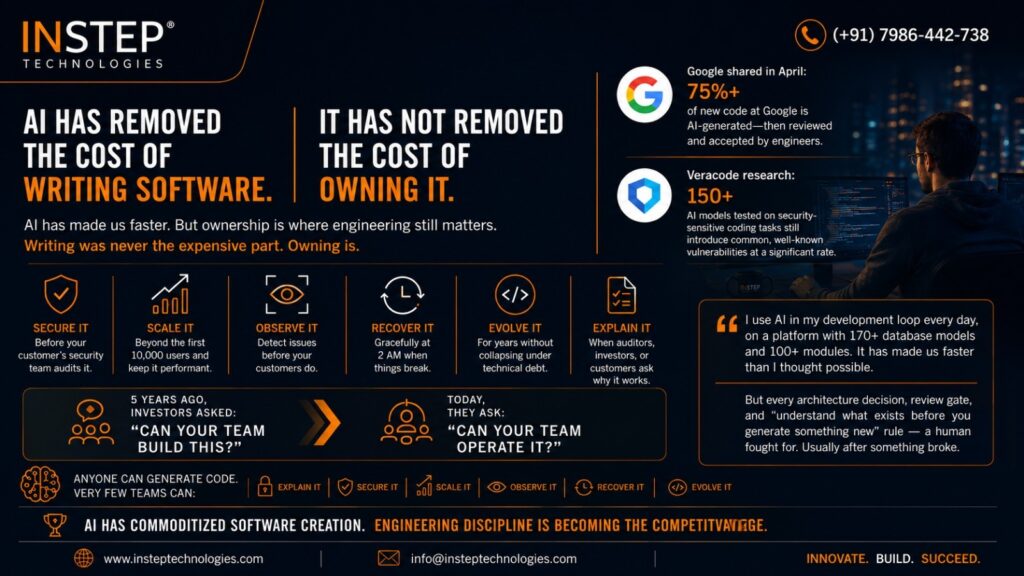
More than 75% of new code at Google is now AI-generated then reviewed and accepted by engineers. Not autonomous. Not unsupervised. But the first draft of most software at one of the world’s largest engineering organizations now comes from a machine.
Around the same time, Veracode published something less discussed. Testing 150+ AI models on security-sensitive coding tasks, they found models still introduce common, well-known vulnerabilities at a significant rate despite dramatic improvements in coding capability over the same period.
Put those together and the real story emerges. It’s not “AI writes insecure code.” That’s old news.
It’s this: AI has removed the cost of writing software. It has not removed the cost of owning it.
Writing was never the expensive part. Owning is. Owning means explaining the code when an auditor asks. Securing it before your customer’s procurement team tests it for you. Scaling it past the first 10,000 users.
Observing it well enough to catch the incident before the angry email. Recovering it at 2 AM. Evolving it for years without it collapsing under its own weight.
I use AI in my development loop every day, on a platform with 170+ database models and 100+ modules. It has made us faster than I thought possible. But every ownership discipline in that codebase the architecture decisions, the review gates, the “understand what exists before you generate something new” rules a human fought for. Usually after something broke.
M&A due diligence has already caught on. The questions acquirers ask have changed:
- How much of this codebase is AI-generated?
- What review process exists?
- Can your team explain why your own code works?
- Five years ago, investors asked: “Can your team build this?”
- Today they ask: “Can your team operate it?”
Because anyone can generate code now. Very few teams can explain it, secure it, scale it, observe it, recover it, and evolve it.
AI didn’t eliminate engineering. It increased the value of engineering discipline.